


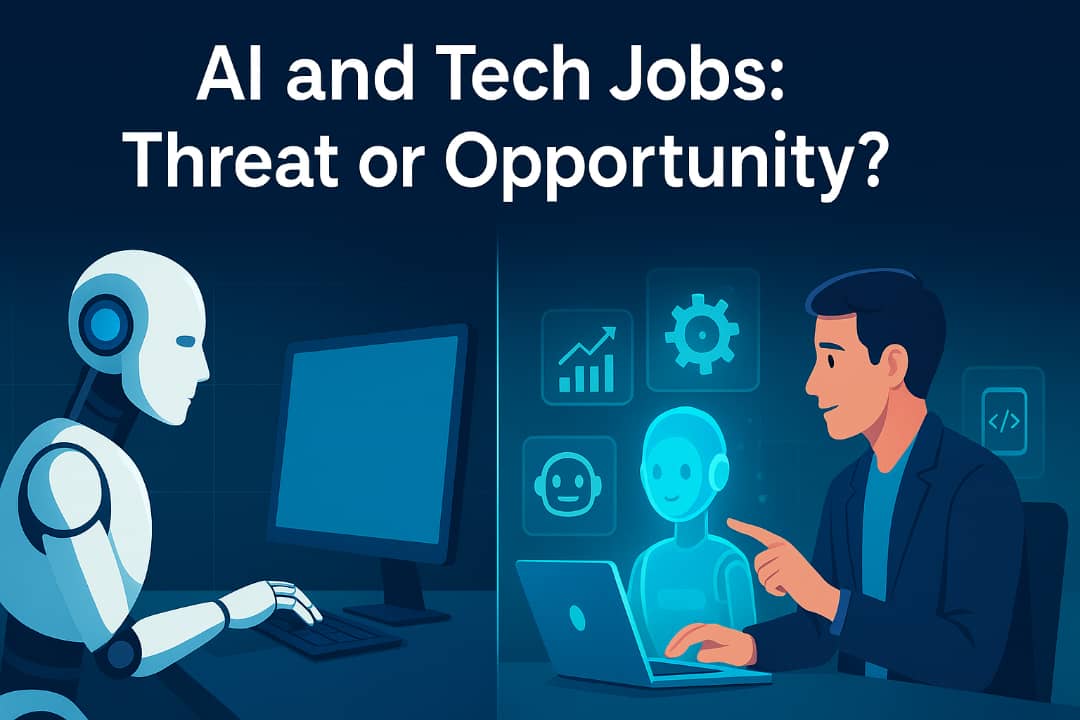
Artificial Intelligence (AI) has become one of the biggest topics in the tech world today. From AI-powered chatbots to automated design tools, the question on everyone’s mind is the same: will AI take over jobs, or create new ones?
The answer is not as simple as “yes” or “no.” AI is reshaping the world of work — but it’s doing so in ways that are more complex, and in many cases, more promising than people think.
The Fear: AI Taking Over Jobs
It’s true that AI can now perform some tasks that were once reserved for humans. For example:
- Automation in Marketing: Tools can generate captions, schedule posts, and even analyze campaign results.
- Web Development: Low-code and AI-assisted platforms can build websites faster.
- Design: AI-generated graphics can create instant visuals.
- Customer Service: Chatbots now handle a large share of customer inquiries.
This has created a fear that human roles in tech — or even entire professions — may become irrelevant.
The Reality: AI Creates New Roles Too
While AI is automating routine tasks, it’s also opening doors to new opportunities. Consider these growing roles:
- AI Specialists & Engineers — People who design, train, and maintain AI systems.
- Data Analysts — Professionals who interpret the massive amounts of data AI relies on.
- AI Ethics & Policy Experts — Guiding responsible and ethical use of technology.
- Digital Marketers & Creators — Leveraging AI to work smarter and personalize campaigns.
- UX Designers & Developers — Adapting digital experiences for AI-driven products.
Instead of eliminating jobs, AI often shifts them toward roles requiring creativity, problem-solving, and human oversight.
History Repeats Itself
This isn’t the first time technology has changed work.
- The printing press automated copying but created publishing industries.
- The internet reduced certain jobs but gave rise to web development, e-commerce, and digital marketing.
- Social media eliminated some traditional advertising roles but created entirely new careers.
AI is following the same pattern — disrupting some areas while creating new ones.
What This Means for Digital Professionals
If you’re building a career in tech or digital skills, AI isn’t something to fear — it’s something to embrace. Here’s how:
- Stay adaptable: Learn how AI tools work in your field.
- Focus on creativity and strategy: AI can generate, but humans direct.
- Develop human-centered skills: Critical thinking, empathy, and storytelling remain irreplaceable.
- Keep learning: The most future-proof professionals are those who evolve with technology.
Conclusion
AI isn’t here to replace all tech jobs — it’s here to reshape them. Yes, some roles may disappear, but many more are being created. The key lies in continuous learning and adaptability.
For digital professionals, the real question isn’t “Will AI take my job?” but rather “How can I use AI to make my skills more valuable?”